How to use the revenue share calculator
Enter the deal you are offered, or the one you plan to ask for.
Product price
What one buyer pays for your course, app, book or community. For a membership, enter what one member pays over their stay.
Sales a month the campaign drives
Only the sales the agency's work creates, averaged across the whole deal. Launches are lumpy: 150 sales in launch month and 18 a month for the next five averages out to 40.
Months in the deal and agency share
The length of the agreement, and the percentage of net sales the agency takes. The 20% default is a hypothetical value to test, not our rate. Market ranges are on our guide to agency revenue share percentages.
Upfront fee
Any one-off fee paid before the share starts. Most deals have one, because the agency fronts months of work.
Refunds, payment and platform fees
The share of each sale that never reaches you. 8% is a placeholder for refunds plus card and course platform fees. App stores keep a much bigger cut, so raise it for an app; our guide to revenue share for digital products covers each format.
Retainer to compare against
The monthly fee the same work would cost on a retainer. $3,500 is where our always-on campaigns start on pricing, so it is a real comparison point.
How the math works: the default deal, line by line
The calculator applies the share to net sales, after refunds and fees. These are the default inputs, run by hand.
| Line | Math | Result |
|---|---|---|
| Gross sales over the deal | $297 × 40 sales × 6 months | $71,280 |
| Net sales over the deal | $71,280 × (100% minus 8%) | $65,578 |
| Agency share | $65,578 × 20% | $13,116 |
| Agency earns on revenue share | $2,500 upfront + $13,116 | $15,616 |
| Agency earns on the retainer | $3,500 × 6 months | $21,000 |
| You keep on revenue share | $65,578 minus $15,616 | $49,962 |
| You keep on a retainer | $65,578 minus $21,000 | $44,578 |
| Cheaper for you | $21,000 minus $15,616 | Revenue share, by $5,384 |
| Break-even sales a month | ($21,000 minus $2,500) ÷ ($54.65 share per sale × 6) | 56 |
The agency's cut of one sale is $297 × 92% × 20% = $54.65. The exact break-even is 56.4 sales a month: at 56 revenue share is still $138 cheaper, and at 57 the retainer is $190 cheaper. "You keep" is before your own costs, such as ad spend or producing the product.
How to pick a realistic sales number
Sales a month is the input that decides the answer, and the one founders guess worst. Build it from your funnel instead: followers who join your email list, times subscribers who buy. The creator income calculator runs that math, and our guide to the creator sales funnel shows what sits at each step.
At the rates from our own launch (about 6% of followers joined the list and about 1.4% of the list bought), 40 sales a month means reaching roughly 2,860 new subscribers a month, which takes about 48,000 new followers a month. If your honest number is 10 sales a month, enter 10: on the default deal you keep $10,616 on revenue share and lose $4,606 on the retainer.
Run three cases before you sign: a flop, your base case and a breakout. The deal you want is the one you can live with in all three.
Case study: a new product launch
We launched a new product. In 2 weeks, these are the results.
- 115kfollowers, starting from zero
- 7,000+emails collected
- 100+purchases across an app, a book and a paid community
No audience, no list and no sales on day one. Organic content earned the follow, a landing page captured the email, and three offers closed the sale. Read the case study.
Revenue share vs retainer calculator: when each one wins
The default deal with one input changed at a time. Static break-even tables for other deal shapes are in revenue share vs retainer.
| Scenario | Agency earns on revenue share | You keep on revenue share | You keep on the retainer | Cheaper for you |
|---|---|---|---|---|
| Flop: 0 sales | $2,500 | -$2,500 | -$21,000 | Revenue share, by $18,500 |
| Slow: 20 sales a month | $9,058 | $23,731 | $11,789 | Revenue share, by $11,942 |
| Base: 40 sales a month | $15,616 | $49,962 | $44,578 | Revenue share, by $5,384 |
| Strong: 80 sales a month | $28,731 | $102,424 | $110,155 | Retainer, by $7,731 |
| Breakout: 120 sales a month | $41,847 | $154,886 | $175,733 | Retainer, by $20,847 |
| 40 sales, 30% share | $22,173 | $43,404 | $44,578 | Retainer, by $1,173 |
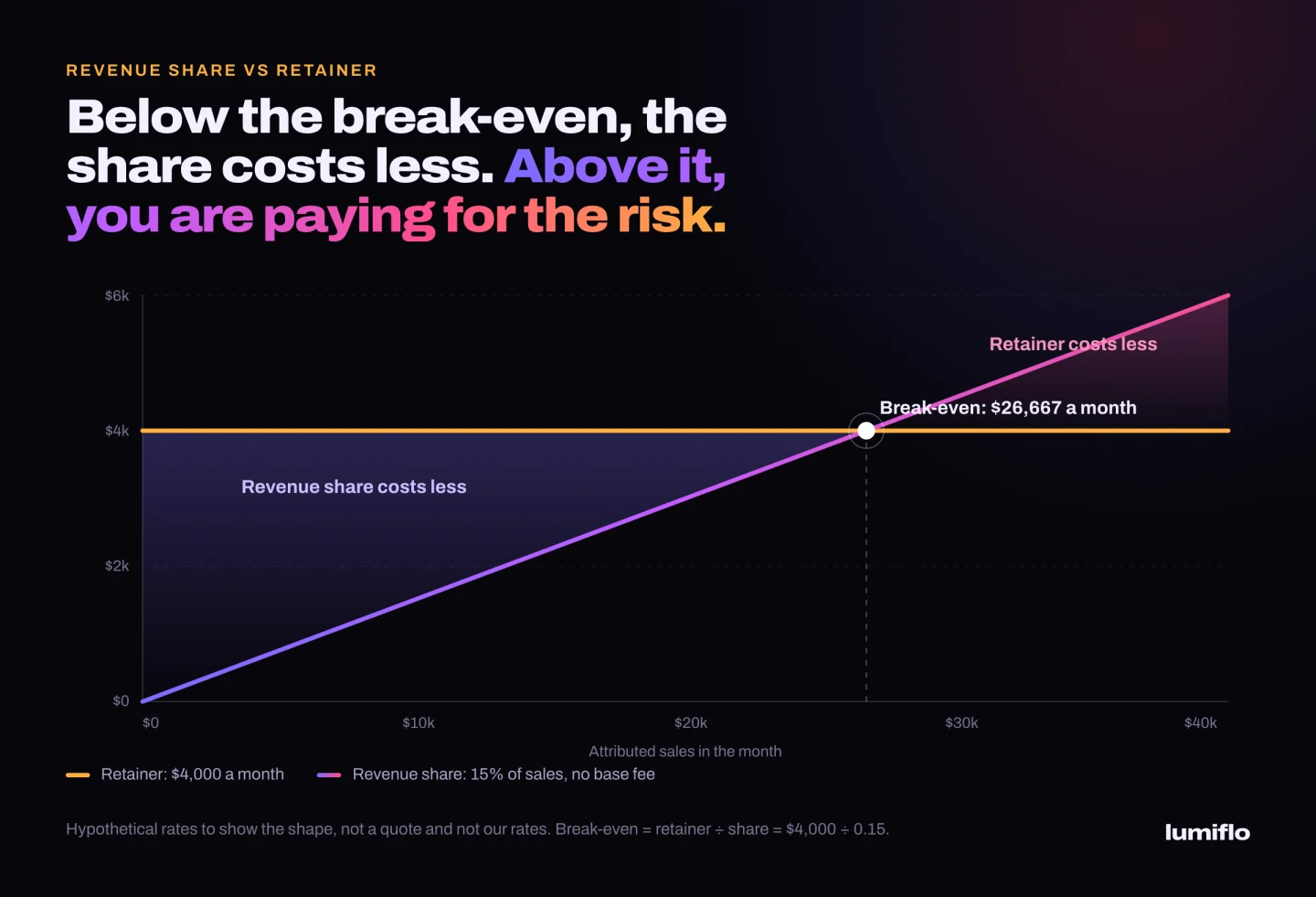
Calculator output, rounded the way the tool rounds. Revenue share wins when sales are uncertain, new or lumpy, which describes most first launches. A retainer wins when you already know the campaign will sell well.
What the agency revenue share calculator leaves out
It assumes every sale counts at one flat rate. Real contracts decide the bill in the details, so check these in any revenue share agreement before you sign.
- Attribution: which sales count as campaign sales (tracked links, codes, the list the agency built) and which you would have made anyway
- Baseline: if you already sell, whether the share applies to all revenue or only to growth above your current monthly sales
- Caps: a ceiling on what the agency can earn in a month or over the deal, which changes the breakout row above
- Tails: whether the agency keeps earning on renewals or repeat buyers after the deal ends, which matters for subscriptions and apps
- Ad spend: who pays for ads, since it comes out of your pocket on either model and is not in this calculator
- Cash timing: a retainer is paid before results; a share is paid after sales land, which is easier on a launch budget
Next steps if revenue share looks like the better deal
Write down your three cases and the break-even. If you want a partner who only wins when your launch does, that is how our revenue share partnerships work: a lower upfront fee plus a share of the sales we help create, tracked through your own checkout. We grow the audience organically, build the list, offer and checkout, and get paid on the result. Almost no agency combines all three.
We are selective, because we only earn when you do, and we set terms per deal rather than publish a percentage. Send us your product, price, audience and launch date through our contact form. We reply within 48 hours with a straight answer on whether revenue share, a retainer or a mix fits your launch.