What a marketing revenue share agreement has to do for a launch
A marketing revenue share agreement is a contract where a marketing partner takes a lower upfront fee, or none, plus a percentage of the sales it helps create. For a new course, app, book or paid community it has three jobs: set the launch date and who builds which part of the funnel, define which money the percentage applies to, and say what happens after launch, when the money arrives and arguments start.
Before anyone drafts a clause, get three things on paper: the launch date, a one-page funnel map (traffic source, landing page, email capture, offer, checkout) and the number that means success at day 30. If you can't write those down, plan the launch first with how to launch a digital product.
This page is a working outline, not legal advice. Have a lawyer review the final contract before anyone signs.
Still deciding between revenue share and a flat fee? The break-even math is in revenue share vs retainer. This page is for getting the contract right.
Revenue share agreement template: the launch and money clauses
Copy the fill-in column and replace every bracket. Brackets like [X]% are placeholders, not recommended numbers.
| Clause | What it says | Fill-in example | What to watch for |
|---|---|---|---|
| Parties and scope | Who signs and which product the deal covers | "[Founder LLC] and [Agency LLC]. Covers sales of [product name], plus its order bumps, upsells and renewals sold through the launch funnel." | "All products" pulls in things the partner never touched. Add new products only by written amendment. |
| Launch date and milestones | When the funnel goes live and what must be ready before it | "Landing page and emails approved by [date]. Cart opens [launch date]. Cart closes [date]. First results review on [launch date + 30 days]." | Tie any delay to the side that caused it. If your approvals run late, the date moves and nobody is in breach. |
| Partner deliverables | What the agency builds and runs | "[N] short-form videos a week on [Instagram, TikTok]; launch landing page; email capture and a [N]-email launch sequence; checkout setup in [platform]; a weekly numbers report." | Write counts and channels, not "marketing support". Vague scope is argued over first when sales disappoint. |
| Founder deliverables | What you supply so there is something to sell | "Finished product delivered by [date]; checkout and payment accounts in Founder's name; approvals within [2] business days; [N] hours of on-camera time a week; customer support and refunds." | If the product or approvals are late, the launch is late. Deals fail on this side as often as the other. |
| Upfront fee | The fixed part, paid whatever the launch earns | "$[amount], paid [50]% on signing and [50]% on the launch date. [Credited / Not credited] against future share payments." | Say whether the fee is credited against the share and whether any part comes back if the launch never happens. |
| Share percentage | The variable part | "[X]% of Net Revenue from Attributed Sales during the Term." | The rate means nothing until Net Revenue and Attributed Sales are defined. For market ranges, see agency revenue share percentage. |
| Ad spend | Who funds paid traffic and how much | "Founder pays ad spend directly to the platforms, up to $[amount] a month unless both sides approve more in writing." | If the partner fronts ad spend, say whether it is repaid before the share is calculated. |
| Cap or step-down | Limits on a breakout month | "[X]% up to $[amount] of Net Revenue per month, then [Y]% above it. Total share capped at $[amount] per [year]." | A cap protects you from a windfall fee. A minimum protects the partner from a flop. |
Test your rate, cap and fee in the revenue share calculator before filling in the brackets.
Revenue share agreement clauses that decide what you actually pay
These clauses move the bill more than the percentage does. Most disputes in a revenue sharing contract trace back to one of them.
| Clause | What it says | Fill-in example | What to watch for |
|---|---|---|---|
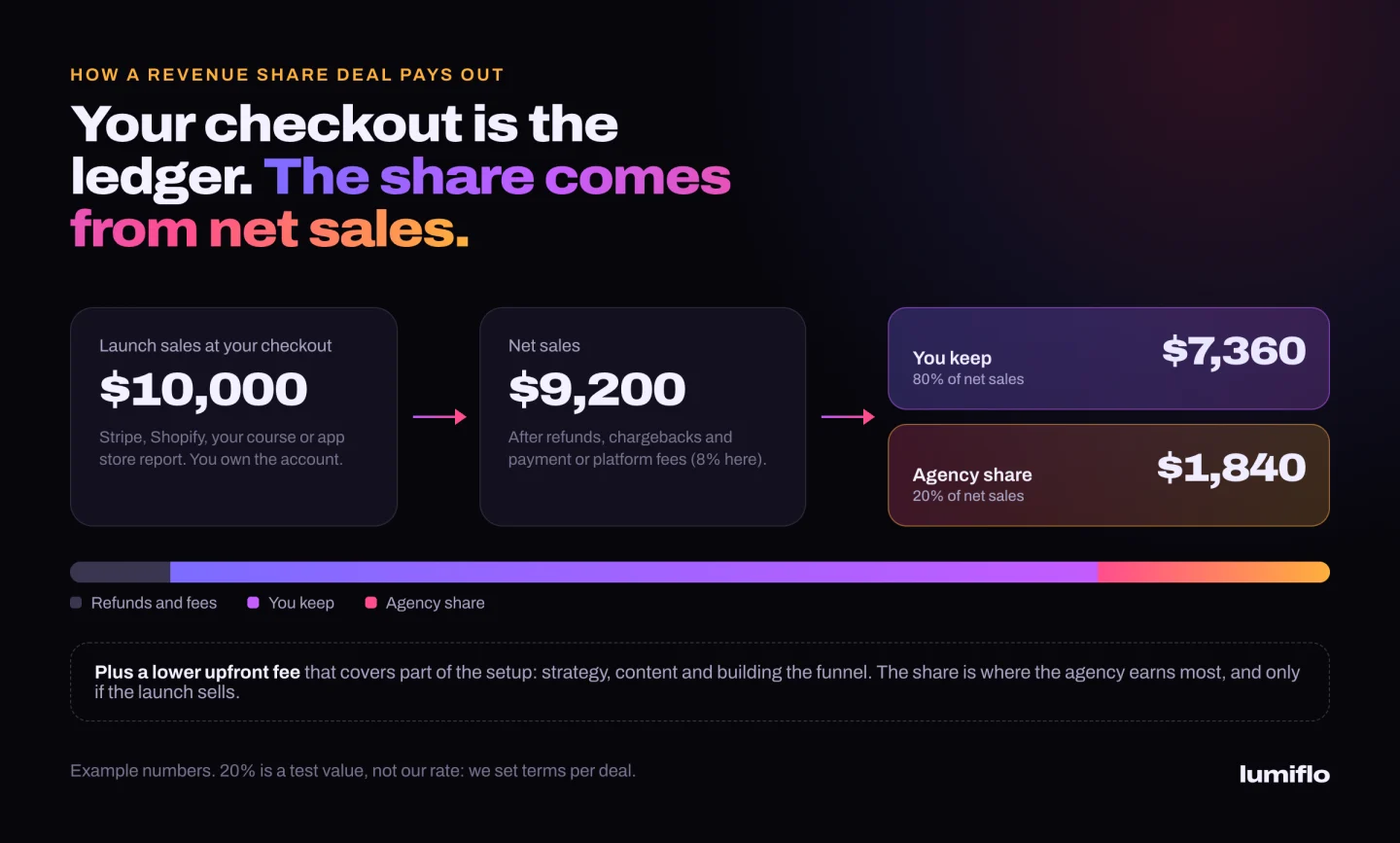
| Revenue definition | Which money the percentage applies to | "Net Revenue means amounts collected from customers, minus refunds, chargebacks and dispute fees, payment processing fees, app store or platform fees actually deducted, and sales tax or VAT collected." | Gross is simpler and always costs you more. If you accept gross, the percentage should be lower. |
| Attribution | Which sales count as the partner's | "A sale is Attributed if the buyer came through [the launch landing page], used a code issued for the campaign, clicked a link tagged utm_source=[partner], or joined the list through a partner-built form within [30] days before buying." | Platform dashboards double count. Say which rule wins when a sale has two sources, and how leaked codes are treated. |
| Source of truth | The one record used for statements | "The [Stripe / Shopify / course platform / App Store Connect] account owned by Founder is the only record used to calculate Net Revenue." | You own the account. The partner gets read-only access on day one, not a monthly screenshot. |
| Baseline | Sales that existed before the partner | "New product: baseline is $0. Existing product: the first $[average of last 3 months] of monthly Net Revenue is excluded." | Without a baseline the partner earns on buyers you already had. For a brand-new launch, write "$0". |
| Reporting and audit | How statements are sent and checked | "Founder sends a statement with an order-level export by the [10th] of each month. Partner may audit the source data once every [12] months on [15] days' notice. If the audit finds an underpayment above [5]%, Founder pays the audit cost." | Ask for order-level data. Make audit rights two-way so you can check claimed attribution too. |
| Payment timing | When the share is paid | "The share on sales made in a month is paid [45] days after that month ends, once the refund window on those sales has closed. Chargebacks after payment are deducted from the next statement." | Card disputes can arrive months later, so settle them by deduction instead of holding all payments. |
Checked November 2026: cardholders typically have 120 days to dispute a card payment (Stripe: disputes); Stripe keeps its processing fee on refunds (Stripe: refunds); the standard US card rate is 2.9% plus 30 cents and a dispute costs $15 (Stripe US pricing).
Gross vs net: what the revenue definition costs in dollars
Take a hypothetical course launch: 500 sales at $197, so $98,500 collected through Stripe. Say 6% of buyers ask for refunds: that is $5,910. Stripe's standard US fee of 2.9% plus 30 cents comes to about $6.01 a sale, or $3,006.50, and Stripe keeps that fee on refunded sales too. Net Revenue before any sales tax is $89,583.50.
So a gross definition charges you a share on almost $9,000 that never reached you, at any percentage. Any sales tax or VAT you collect widens the gap, because that money belongs to the tax authority.
For apps, write the store fee in by reference, not as a number. Apple's App Store Small Business Program takes 15% on paid apps and in-app purchases for developers under $1 million in yearly proceeds, with the standard commission above that. Google Play's service fees for US users changed on June 30, 2026 and now vary by product type and install date. "The fee the store actually deducted" stays correct when rates change.
Disputes are the slow leak: each one Stripe receives in the US costs $15 on top of the money returned. A share paid at day 45, with later chargebacks deducted from the next statement, keeps both sides whole without freezing four months of payouts. For the full revenue model on a course, community or app, see revenue share for digital products.
Term, exit, tail and ownership: the clauses that protect you after launch
The launch takes weeks. These clauses run for months and decide what you keep if the deal ends.
Term
Fill in: "This agreement runs [6] months from the launch date, then month to month." Start the clock at launch, not at signing, so the build weeks before launch don't eat the term.
Termination and exit
Fill in: "After the first launch cycle, either side may end this on [30] days' written notice, or at once for a material breach not fixed within [10] days. On exit, Partner hands over logins, files and drafts within [7] days." Avoid early termination penalties.
Tail period
Fill in: "For [3] months after the end, Partner earns [Y]% of Net Revenue from customers Attributed during the Term, including renewals they started." Tie the tail to customers won during the term, never to all future sales. With no tail at all, good partners won't sign.
Ownership of accounts, lists and creative
Fill in: "Founder owns the social accounts, domain, email list, customer data, checkout account and all final creative once paid for. Partner keeps its templates and methods." Any account the partner opens for the launch is transferred to you at launch, and the list is exportable as a CSV.
Confidentiality
Fill in: "Sales data, customer lists and the unreleased product stay confidential for [2] years after the end, and Partner may not use Founder's customer data for any other client." Also agree whether the partner may show the results in its portfolio.
Disputes
Fill in: "A disputed statement goes first to a [14]-day good-faith review using the order export, then to [mediation / arbitration] in [state], under [state] law. Undisputed amounts are paid on time." That last line stops one contested order freezing the whole payment.
How the agreement should define launch success
The best revenue share agreement clauses also say what a good launch looks like, so both sides know by day 30 whether to double down, adjust or walk away. Put three kinds of numbers in a schedule: leading signals (views, followers), funnel signals (emails collected, landing page conversion) and the result (purchases and Net Revenue in the checkout).
That's how we track our own launches. In our case study, a new product launched from a brand-new Instagram account: 0 followers on Oct 7, 2026, then 15,720,857 views and 148,153 followers in the 30 days to Nov 9. Those were the early signals. What counted came further down: 7,000+ emails and 100+ purchases across an app, a book and a paid community, all recorded at checkout.
Write the checkpoints plainly: "Day 14: funnel live and tracking verified. Day 30: review against Schedule A. If Net Revenue is below $[amount] at day 60, either side may end the agreement without a tail." A clean exit for a launch that misses makes it easier to sign one that might hit.
Case study: a new product launch
We launched a new product. In 2 weeks, these are the results.
- 115kfollowers, starting from zero
- 7,000+emails collected
- 100+purchases across an app, a book and a paid community
No audience, no list and no sales on day one. Organic content earned the follow, a landing page captured the email, and three offers closed the sale. Read the case study.
Common revenue share agreement mistakes
Using a generic revenue sharing contract. Templates written for business partners, licensing or investors skip attribution, launch dates, funnel deliverables and account ownership.
Letting the partner own the checkout or the accounts. You lose your source of truth and your audience in one go. Keep both in your name.
No tail, or a tail on everything. No tail invites the partner to walk early. A tail on all future sales charges you for growth you built yourself.
Picking a partner who can't build the funnel. A revenue share only works if the partner controls enough of the path to the sale. How to find a revenue share marketing partner covers what to check before you get to the contract, and our landing pages and funnels page shows what that part of the build includes.
Revenue share agreement checklist before you sign
Anything left blank is where the first dispute starts.
- Launch date, cart open and close dates and the first review date are written in
- Each side's deliverables have counts, channels and deadlines
- The upfront fee, its timing and whether it is credited against the share are stated
- Net Revenue lists refunds, chargebacks, payment fees, store fees and sales tax as deductions
- One checkout account you own is the source of truth, with read access for the partner
- Attribution names the pages, codes, UTM tags and list forms that count, plus a window in days
- A baseline is set, even if it is $0
- Statements, audit rights, payment timing and chargeback deductions are spelled out
- Ad spend has an owner and a monthly ceiling
- Term, notice period, tail length and tail percentage are fixed
- Accounts, domain, list, customer data and creative are in your name
- A lawyer has reviewed the final draft