Agency revenue share percentage by deal type, as of 2026
The same words, revenue share, cover very different deals. These are the ranges we could verify from published 2026 sources, plus two reference points from outside agencies that founders often use to judge a split.
| Deal type | Typical percentage | What it is calculated on | What usually comes with it |
|---|---|---|---|
| Pure revenue share (little or no base fee) | About 10% to 30% | Attributed revenue | The agency carries most of the cost and the wait. Clicks Geek ties the rate to margin: about 20% for a 60% margin business, 10% to 15% for tighter margins. |
| Hybrid: reduced base fee plus a share | Single digits up to about 10% | Attributed revenue, or revenue above a baseline | A base at roughly 50% to 70% of a normal retainer. One published example: $3,000 a month plus 10% of revenue above the baseline. |
| Ecommerce revenue share specialists | About 5% to 10% | Total, channel or incremental revenue | Published examples include 5% with no upfront fee, 5% of email revenue after a $900 setup fee, and 10% with no long-term contract. |
| TikTok Shop agencies | About 5% to 10% | Incremental GMV | On top of a retainer, at the tier where retainers run about $12,000 to $15,000 a month. |
| Reference: talent manager commission | 15% to 20% is the norm, sometimes 10% to 20% or more | Gross earnings from deals they source | No upfront fee. Covers deal flow and negotiation, not growth or a funnel. |
| Reference: course and digital product affiliates | 30% to 50% for $97 to $497 courses; 20% to 35% for $997 and up | One sale the affiliate referred | No fee, no ongoing work. The affiliate brings a buyer and is done. |
All ranges are self-reported by agencies, managers or publishers and vary by niche. Sources, checked November 2026: Clicks Geek, eCommerce Fast Lane on revenue share pricing and its 2026 agency roundup, Darkroom, Pfeiffer Law, Make Influence and Matt McWilliams.
Why the percentages range from 5% to 50%
The low end and the high end describe different jobs. A 5% ecommerce deal usually sits on top of a retainer and applies to a business already doing real volume. The agency is paid mostly by the fee, and the share is a bonus for growth. A 30% to 50% affiliate commission is the opposite: no fee at all, paid on one sale the affiliate brought in, with nothing owed after that.
The pattern is consistent. The more of the cost, risk and wait an agency carries, and the more of the revenue would not exist without it, the higher the percentage. The more you pay upfront, and the more sales you already have, the lower it goes. That is also why platforms that just host your product take small cuts: Maven, for example, keeps 10% as a platform fee on course sales.
For creator and founder launches of a course, app, book or paid community, we could not find a published benchmark for agency shares. The two reference points bracket it. A talent manager takes 15% to 20% for bringing in brand deals. An affiliate takes 30% to 50% for one referred sale. An agency that builds the audience, the offer page and the funnel for a brand-new product is doing more than either, and much of the launch revenue would not exist without that work. That argues for the upper part of the agency range. An upfront fee pulls it back down. If you are still choosing between an agency and a manager, see creator management agencies explained.
What pushes a revenue share percentage up or down
Seven levers decide where a fair split lands. Most negotiations are really about these, not the headline number.
Who funds the ad spend
If you pay the platforms directly, the agency is risking only its time. If the agency fronts the ad budget, it is risking cash too, and the percentage has to rise to cover it. This one lever can roughly double a fair rate.
Who builds the offer and funnel
An agency that only posts content touches one link in the chain. One that also builds the landing page and funnel, the email sequence and the checkout controls more of the result, and can fairly ask for more of it.
The size of the upfront fee
Every dollar paid upfront is a dollar the agency no longer needs to recover from sales. Hybrids exist for this reason: Clicks Geek describes base fees at 50% to 70% of a normal retainer, paired with a smaller share.
Your product margin
A share comes out of gross margin. Digital products, where payment and hosting costs are commonly a few percent, can carry a larger share than physical goods. eCommerce Fast Lane's 2026 roundup suggests skipping revenue share below about 40% gross margin.
Your existing audience and baseline
If you already sell $20,000 a month, a share on all revenue pays the agency for sales it did not create. A share on revenue above an agreed baseline lets the percentage be higher while the bill stays fair.
Term length
A share on a three-month launch and a share for the life of a subscriber are different deals at the same rate. Recurring products like apps and paid communities need an end date, or a lower rate the longer it runs.
Caps and step-downs
A step-down (say, a lower rate above a revenue threshold) or a cap protects you from a breakout month. The more protection you ask for on the upside, the higher the starting percentage an agency will want.
What 10%, 20% and 30% mean in dollars for a launch
Hypothetical launches for founder-led digital products, to show the scale of each percentage. The rates span the published market range. They are not our rates.
| Hypothetical launch | Revenue counted in the deal | At 10% | At 20% | At 30% |
|---|---|---|---|---|
| Online course: 300 sales at $500 | $150,000 | $15,000 | $30,000 | $45,000 |
| Paid community: 400 members at $49 a month, staying 6 months on average | $117,600 | $11,760 | $23,520 | $35,280 |
| App: 2,000 annual subscriptions, $50 each after store fees | $100,000 | $10,000 | $20,000 | $30,000 |
| Book or ebook bundle: 2,500 sales at $29 | $72,500 | $7,250 | $14,500 | $21,750 |
The community and app rows depend heavily on term. If the share ran for the full life of each member or subscriber instead of a fixed window, the same percentage would cost more every month the product keeps them.
Worked example: what you keep after the share
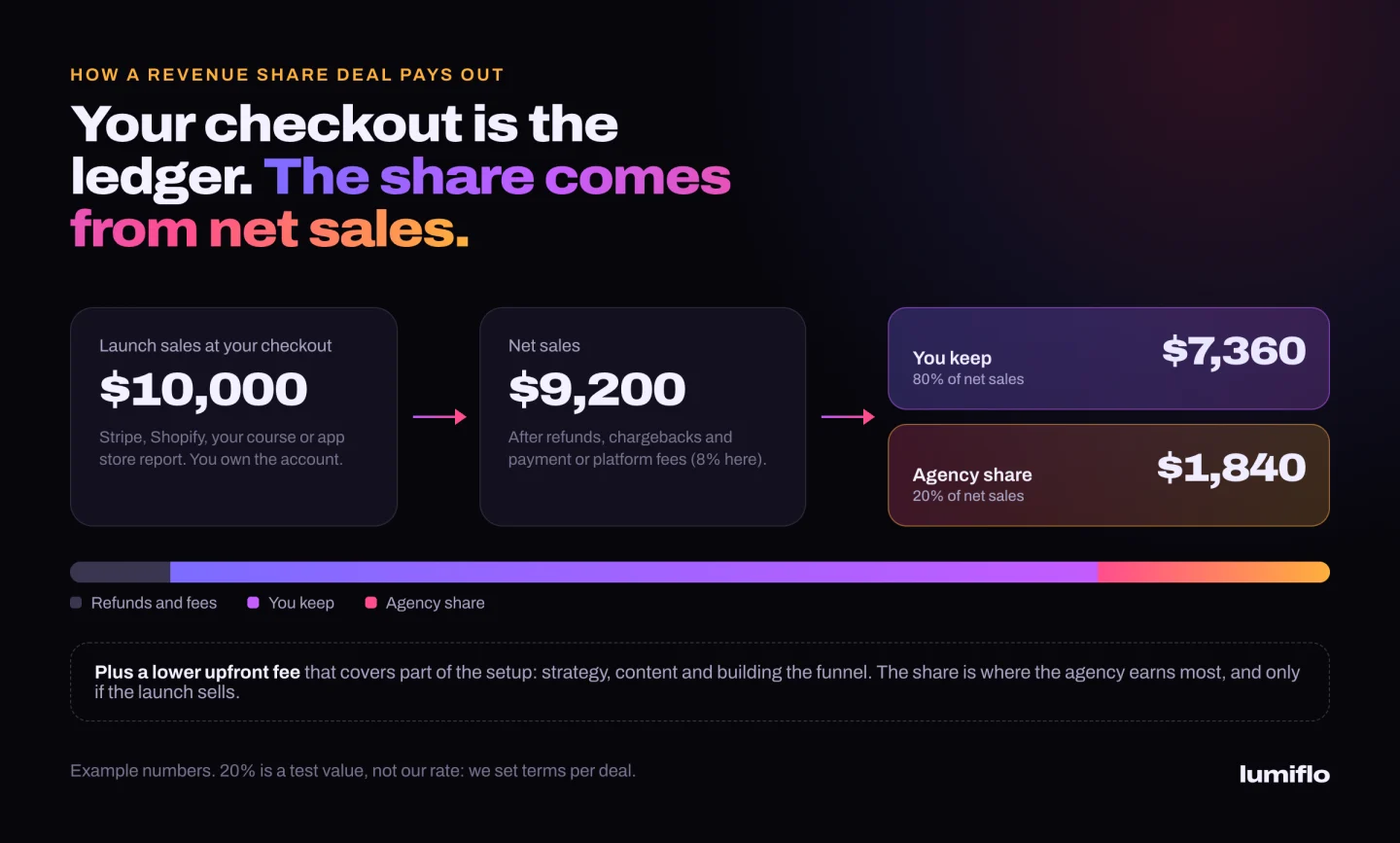
Take the hypothetical course launch above: 300 sales at $500, so $150,000 gross. Assume 5% is refunded ($7,500) and payment and platform fees take another 4% ($6,000). Net revenue is $136,500.
Deal A: you fund the ads. The agency charges $3,000 upfront plus 20% of net revenue, and you spend $25,000 on ads paid directly to the platforms. The agency earns $3,000 + $27,300 = $30,300. You keep $136,500 minus $30,300 minus $25,000 = $81,200, before your own time and tools. If the same 20% were on gross instead of net, the share would be $30,000, so the base of the calculation alone is worth $2,700 here.
Deal B: the agency funds the ads. Same $3,000 upfront, but the agency puts in the $25,000 ad budget and asks for 40%. The share is $54,600. The agency's take after recovering its ad spend is $32,600. You keep $136,500 minus $57,600 = $78,900.
The 40% deal looks twice as expensive. In this example you keep $2,300 less than in Deal A, in exchange for risking zero ad dollars. If the launch flops, Deal B is the safer one for you. That is why the headline percentage alone tells you very little: compare what you keep in each scenario. To model your own numbers, use the creator income calculator.
How to sanity-check a revenue share split before you sign
Ten minutes in a spreadsheet tells you whether a fair revenue share split is fair for both sides. A split that only works for one side tends to fall apart halfway through.
Write down three outcomes
A flop, a base case and a breakout. For the course example: $20,000, $136,500 and $400,000 in net revenue. Use your own list size, past conversion and price, and see how to launch a digital product if you have no history yet.
Work out the agency's effective hourly rate
Estimate the hours the work takes. Say 250 for strategy, content, the funnel, launch emails and optimization. On Deal A, the agency earns $7,000 in the flop ($28 an hour), $30,300 in the base case ($121 an hour) and $83,000 in the breakout ($332 an hour).
Compare the base case with a fixed fee
If the base case pays far less than the same work would cost as a project fee, the agency is either expecting more sales than you are or will quietly do less. Check fixed-fee ranges in how much a social media agency costs.
Check your own margin in every scenario
Subtract the share, the upfront fee, ad spend, refunds and payment fees. If the flop leaves you badly in the red because you funded the ads, a higher share with agency-funded ads may be the better deal.
Decide what happens in a breakout
SaaS Hero's 2026 pricing guide suggests capping performance pay at 130% to 150% of a market-rate retainer. A step-down rate above a revenue threshold is a softer option that keeps the agency motivated.
Red flags in a revenue share percentage
These are signs the number itself is off. For the contract clauses that sit around it (attribution, gross versus net, term and exit), see revenue share vs retainer.
- A share on all revenue, including sales you already had, with no baseline.
- A full retainer, plus a percentage of ad spend, plus a revenue share. That is three fees for one job.
- A share on channels the agency never touches, such as your existing affiliates or wholesale.
- A percentage that is a large slice of your gross margin. Clicks Geek's example of 20% on a 60% margin business is about a third of margin; much more than that leaves little room for you.
- No end date on a share of recurring revenue from a community, membership or app subscription.
- The same high rate no matter who funds the ads.
- A share paid out before your refund window closes, with no clawback for refunded sales.
- An agency that names a percentage before asking about your margin, price, audience or past sales.
How we set a revenue share percentage
We don't publish a percentage, because no two deals carry the same risk. We set it per deal using the levers above: whether paid ads are part of the plan, how much of the audience, offer and funnel we build, the upfront fee, your margin and what you already sell. Terms are written down before any work starts, and sales are tracked through your own checkout.
We are selective because we only win when you do. The deals that fit best are founder-led launches of a course, app, book or paid community where we grow the audience organically and build the sale behind it. How the model works is on our revenue share partnerships page, and what one launch produced is in our case study.
Case study: a new product launch
We launched a new product. In 2 weeks, these are the results.
- 115kfollowers, starting from zero
- 7,000+emails collected
- 100+purchases across an app, a book and a paid community
No audience, no list and no sales on day one. Organic content earned the follow, a landing page captured the email, and three offers closed the sale. Read the case study.