What a revenue share marketing partner is really buying
A revenue share marketing partner works for a lower upfront fee and makes most of its money from a percentage of the sales it helps create. So when you pitch one, you aren't hiring a vendor. You're asking a team to invest months of work in your launch. It says yes when it can see a believable path from attention to money, and no when a link in that path is missing.
For a course, app, book or paid community, the path has six links: content that earns attention, a profile that turns viewers into followers, a landing page that turns followers into signups, an email list that warms them up, a launch with a deadline, and purchases through a checkout both sides can see. A partner that only handles one link, say posting, is betting its fee on five it doesn't touch. That's why the good ones ask hard questions about all six before they talk terms.
Your job before you pitch is to make that path easy to believe. This page shows you how: what partners screen for, a scorecard to check yourself against, exactly what to send, where to look and what the first month looks like once someone says yes. For how these deals are structured and paid, see our revenue share partnerships page.
The six things a growth partner on revenue share screens for
Each one is a reason to say yes or no. Each card ends with what you can do this week to move it toward yes.
An offer with proof
A partner wants evidence that strangers will pay: past sales, presales, a waitlist, a cohort that sold out, or a pile of 'where do I get this' comments and DMs. This week: screenshot every signal you have into one document. If you have none, open a waitlist page and post an 'early access' call before you pitch anyone.
Margin that can carry a share
The share comes out of what you keep after refunds, platform fees and delivery. A $300 course that costs $20 a sale to deliver has room. A $40 physical product that costs $25 to make and ship usually doesn't. This week: write down your price, cost per sale and refund rate in dollars. Partners trust founders who already know them.
Checkout tracking a partner can read
The partner is paid from your sales report, so no tracking means no deal. Stripe has a View Only role that can see payments and download reports but can't refund, pay out or edit settings. Shopify gives partners collaborator access limited to the permissions you choose. App Store Connect has a Sales role for sales and download data. This week: make one test purchase and find it in the report.
A founder on camera, or willing to be
Organic growth for a founder-led product runs on a face and a voice. A partner can write the hooks, plan the shoots and edit, but it can't invent your expertise. This week: film three 30-second answers to questions your buyers ask. Rough takes are fine. They prove you'll show up.
A launch date
A date turns an idea into a plan a partner can work backward from: content first, then the landing page, the list and the cart-open emails. 'Sometime next year' gets a polite no. This week: pick a cart-open day, not a month, and put it in the first line of your pitch.
Decision speed
On revenue share, every week of waiting is a week the partner works unpaid. Founders who approve content within a day get more from the same team than founders who take a week. This week: decide who signs off (ideally you, alone) and block an hour a day for approvals during the build.
Revenue share readiness scorecard: check yourself before you pitch
Score one point for each line that is true today. 10 to 12: pitch now. 6 to 9: pitch, and name the gaps you're fixing and by when. Under 6: fix the gaps first, or ask for a fixed-fee launch, which is usually the better deal at that stage.
- I can say what my product is, who it's for and what it costs in two sentences.
- I have proof of demand: past sales, presales, a waitlist or repeated requests.
- I know my margin per sale in dollars, after refunds and fees.
- My checkout (Stripe, Shopify, a course or community platform, or an app store) records every sale, and I can grant read-only access.
- I've made a test purchase and seen it appear in that report.
- I have a launch date, written as a specific day.
- I'll be on camera, or someone on my side will be the face of the product.
- I can give 3 to 5 hours a week to filming and approvals.
- My social accounts, domain and email platform are in my name, or I'm ready to set them up that way.
- I have assets a partner can use now: videos, photos, real buyer testimonials, a sales page draft or product screenshots.
- I can make decisions without waiting on a cofounder, investor or committee.
- I can pay a lower upfront fee, so the partner isn't funding the whole build alone.
What to send when you pitch a revenue share partner
Put all of this in one email or one contact form. A pitch a partner can answer on the first read beats a request for a call.
| Send this | Example | Why the partner asks |
|---|---|---|
| Product link | Your sales page, waitlist page, app store listing or a short demo video | To judge the offer the way a buyer would, in 30 seconds |
| Price and format | A $297 course, a $29 a month community, a $24 book | Price sets how many buyers the launch needs, and how much attention it takes to find them |
| Margin per sale | $297 price, about $25 in fees, refunds and delivery, so about $272 kept | The share comes out of this number, not the price |
| Audience and list size | Followers per platform, average views, email subscribers. Zero is a valid answer. | Building from zero is a different plan from selling to 20,000 people who already know you |
| Proof of demand | Past launch revenue, waitlist count, presales, screenshots of buyer DMs | To judge the odds before agreeing to work for a share |
| Launch date | Cart opens on a named day | To plan the build backward and check the team has capacity |
| Assets | Existing videos, photos, buyer testimonials, brand files, the product itself | Ready assets shorten the build and lower the risk |
| Checkout and access | Stripe with a View Only seat, a Shopify collaborator invite, or an App Store Connect Sales role | To confirm every sale can be counted before work starts |
| Your time and budget | Hours a week you can film; the upfront fee you can commit | A lower upfront fee only works when both sides put something in |
Skip the 30-slide deck. Partners read the product link, the numbers and the date first, and decide from those.
Where to find an agency for revenue share, and how to vet it
Few agencies advertise revenue share, so searching for a marketing agency that works for a percentage of sales mostly turns up affiliates, lead resellers and pay-per-lead shops. Look instead for teams whose work already covers the whole path: agencies that build funnels as well as content, strategists who have run course and app launches, and operators who have grown an account from zero for a product of their own. A team that has launched its own product understands launch risk from the inside.
Three places beat directories. Launches in your niche: find a launch you admired and ask the founder who ran it. Agencies you'd hire anyway: send one line asking whether they take launch work on a share. How fast and how straight the answer comes tells you a lot. Founders a step ahead of you: people who sold a course or community last year know who delivered and who disappeared after the first invoice.
Vet before you sign. Ask what they build in month one, who owns the accounts, and how a sale gets counted. Our guide to commission-based marketing agencies lists the red flags that show a 'no fee' offer is really an affiliate. When terms arrive, check every clause against the revenue share agreement guide, run your flop and breakout numbers through the revenue share calculator, and compare the split with typical agency revenue share percentages.
The first 30 days with a launch partner for a course, app or book
This is what the first month of a revenue share partnership should look like. If a partner can't describe its own version of this before you sign, keep looking.
Days 1 to 3: terms in writing
The upfront fee, the share, which sales count, the term and the exit, all signed before any work starts. Every account stays in your name, and you grant read access.
Days 3 to 7: tracking before content
A dedicated landing page, tracked links and codes, and a test purchase that shows up in the shared report. If you sell through Stripe payment links, they accept UTM codes such as utm_source and utm_campaign when the link is set to redirect after payment.
Week 2: positioning and the profile
Hooks, angles and the product's promise, rewritten for strangers. The profile (bio, link, pinned posts) rebuilt so every viewer has one obvious next step: join the list.
Weeks 2 to 3: a content batch and the funnel
You film in blocks while the partner scripts and edits. In parallel, the landing page, the welcome emails and the cart-open sequence get built and tested.
Weeks 3 to 4: go live
Content goes out daily. The partner tracks which videos turn viewers into followers and followers into signups, and makes more of what works. Our own campaigns usually go live 3 to 4 weeks after the brief is agreed.
Day 30: the first report
Views, follows, signups, cost per signup if ads are running, and the confirmed cart-open date. From here every week runs the same loop: find the weakest step between content and purchase, fix it, report the numbers.
What 30 days of organic growth looked like on our own launch
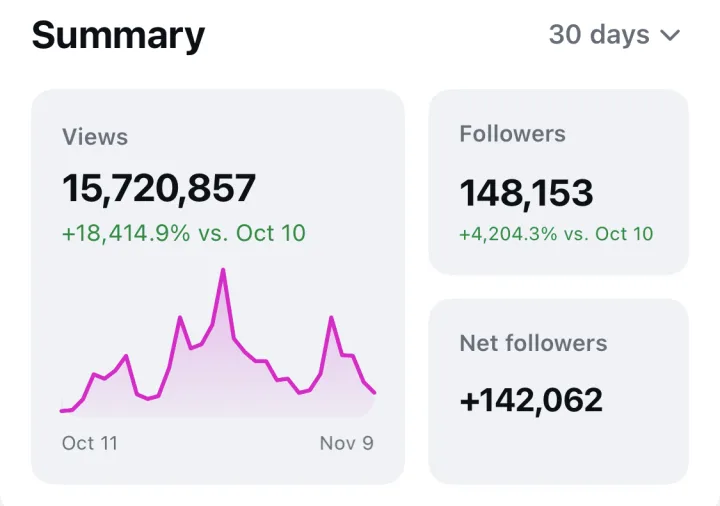
Case study: a new product launch
We launched a new product. In 2 weeks, these are the results.
- 115kfollowers, starting from zero
- 7,000+emails collected
- 100+purchases across an app, a book and a paid community
No audience, no list and no sales on day one. Organic content earned the follow, a landing page captured the email, and three offers closed the sale. Read the case study.
Why most agencies say no to revenue share, and how to be the exception
Most agencies turn revenue share down for three reasons: they pay their team every month and wait for sales, they control only one link in the path, and attribution turns into arguments. We cover each in revenue share vs retainer.
Every line on the scorecard answers one of those fears. Proof and margin answer 'will this sell'. Clean tracking answers 'will we agree on the number'. A launch date and fast decisions answer 'how long will we wait'. An upfront fee answers cash flow. A founder who brings all of that isn't asking for a favor. They're offering a good bet.
That's how we decide too. We're selective: we charge a lower upfront fee plus a share of the sales we help create, tracked through your own checkout, and we set terms per deal rather than publishing a percentage. We say yes when we believe in the offer and can build the whole path, from the first video to the purchase. If revenue share doesn't fit, we say so and point you to a fixed-fee launch on our pricing page.